Showing posts with label divers classroom. Show all posts

Saturday, 29 March 2014

Why games are good for learning?

Games benefit children in many areas like those of cognitive, social, emotional and communication and language development too.  Also it will capture children’s attention in learning. Take a look at the info-graphic below for an overview of why games are good for leaning.
Why Games are Good for Learning

I like to play treasure hunt, word games and many more with my niece and nephews. They really enjoyed it. In the treasure hunt game, in order to rescue Pirate Jack from the tree, they have to make four words using the letters on the coconuts. They can repeat this game as many times as they wish. I am thinking of using these games for to play with the children during my practicum period.

Constructing a tower using blocks


While searching the web I found this musical chair reading game for Miss Sporn's classThey invented musical chair in a new way. They placed books on each of the chair and played the music. When the music stopped children needed to stop, sit down and start reading! Then when the music started again they walked around in a circle until the music stopped – then sit down and start reading again.  It seems very interesting and lot of fun and something different to develop our reading interests.

Lining for a game of hopscotch


Don't underestimate child's play. It may look like leisure time,  but when children are playing house, fighting imaginary dragons or organising a game of hopscotch, they're actually developing crucial life skills — and preparing their brains for the challenges of adulthood.

Tuesday, 25 March 2014

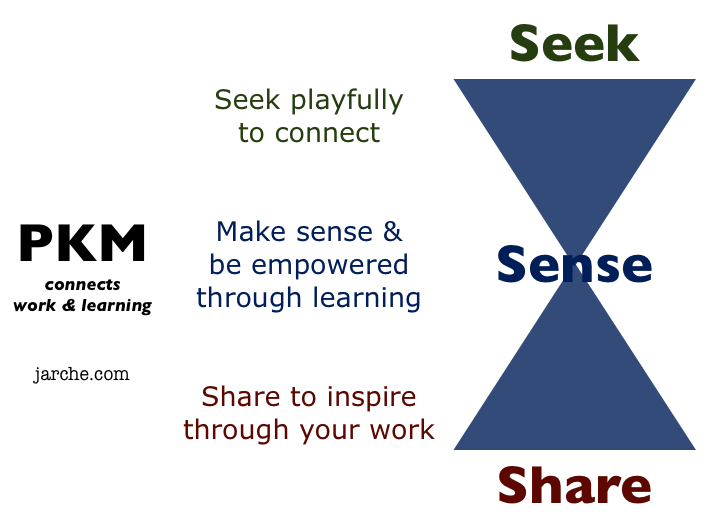
PKM PROCESS AND YOUR PLN

Personal Knowledge Management (PKM) is about taking a personal or individual perspective to Knowledge Management rather than an organisational or corporate one.

In short we have to say PKM is taking responsibility for what you know, who you know- and what they know.

PKM Concept


PKM is mostly focused on individuals who must negotiate and transcend the artificial barriers between their teams, communities of practice, and networks. Inside that person’s head, there are no knowledge barriers. However, discerning with whom and when to share, remains a key part of effective PKM. Social learning requires social intelligence, but organisations have to establish ways to support the multifaceted knowledge worker, or continue to face the knowledge sharing paradox. Understanding that people, not management systems, enable knowledge flow would be a good start.

Reading Alicia's blog  I found she posted some relevant information about PKM and explains it very clearly.

Reflecting on PKM, my thinking is that it connects personal philosophy very well. My personal philosophy of education is primarily based on the ideas of behaviorism. I feel that a behaviorist approach will be necessary in a special child as well as normal child. Behaviorists believe that reinforcement is crucial when it comes to mastering a skill. This is definitely true as most of the students’ need repetition for mastering their skills.

I believe that an effective learning environment begins with a positive climate. Establishing positive classroom environment and strong relationships with students is the first step in proactive behaviour management and individualization. In order to establish these relationships it is imperative to express sensitivity, provide specific positive feedback, and have consistent two-way communication with the families of my students.  The information these relationships will provide will allow me to have greater regard for my students’ perspectives and to better engage my students.


Monday, 24 March 2014

TOOLBELT THEORY

Thank you  Safee  for sharing an insight of "toolbelt theory". I had never come across this theory until I joined EDC3100 module. I fount it is an amazing and very interesting theory as I read through “Toolbelt Theory for Everyone” posted in Ira David Socol's blog. The article  is based on the concept that students must learn to assemble their own readily available collection of life solutions. They must learn to choose and use these solutions appropriately, based on the task to be performed, the environment in which they find themselves, their skills and capabilities at that time, and the ever-changing universe of high and low-tech solutions and supports.


Toolbet of "Information"


According to Socol(2009) “ We as humans differ, our tasks differ, our environments differ, our circumstance differ and we pick the appropriate tool”

So, the Toolbelt theory is designed to:
• Break the dependence cycle
• Develop lifespan technology skills  
• Limit limitations
• Empower student decision making
• Prepare students for life beyond school

All these information inspired me to look back over the weeks and find the ICT tools that I have added to my own personal and future teaching Toolbelt,


Reference

Scocol,l.(2009) .the Toolbelt and universal Design Education for everyone, Retieved  march 6 2014 from http://speedchange.blogspot.com/2008/05/toolbelt-theory-for-everyone.html

Wednesday, 19 March 2014

21ST CENTURY LEARNER

I really want to share this YouTube video with my friends. I enjoyed watching this video because it made me think critically about my future classroom in terms of my teaching and how my students are learning. I really enjoy finding new information and integrating new forms of technologies in my teaching. I truly believe no one sees more clearly than us educators, how the technologies we use in our daily lives influence how students learn. Students have changed, educators have changed, and learning itself has changed. Also learning tools have evolved accordingly.


This is a student's final video project for Master in Education Media and Design Technology.  This video asks faculties that teach students of different age categories to consider "What if they incorporate appropriate technologies to help prepare their students for success in the 21st Century".

WHAT IS "ICT AND PEDAGOGY", DO YOU KNOW?

ICT – What is it?

ICT (information and communications technology - or technologies) is an umbrella term that includes any communication device or application, encompassing: radio, television, cellular phones, computer and network hardware and software, satellite systems and so on, as well as the various services and applications associated with them, such as videoconferencing and distance learning. ICTs are often spoken of in a particular context, such as ICTs in education, health care, or libraries.

What is Pedagogy? 

Pedagogy is the way we teach, the strategies behind our teaching and the focus of our teaching. Pedagogy is also about learning; one cannot teach without being a learner. Understanding what is involved in the process of being a learner is part of pedagogy.

Today, this understanding is more important than ever. Educators need to encourage learners (including ourselves) to be creative, adaptable and innovative to fulfil this future. According to Thibault (2000) visual aids are key tools in learning and development since they help increase a student's interest in a subject. They help break the mundane cycle in certain settings, such as in classrooms. Visual aids also tend to be more interactive, helping an audience become more engaged in their own learning.

In one of my colleagues blog I found that the blogger Sanna posted a link to a YouTube on versatile tablet and her reflection. As I read the post and watched the video I felt truly inspired by it. Visit Sanna's blog here Sanna Ahmed's Blog

It reminded me of my childhood education. We never get any opportunities to explore and play with tablets, computers or any ICT tool in our education setting. But today with the aid of these ICT tools children can learn things in different ways. Children focus their attention and interest to the lessons when ICT is incorporated. Due to this factor I strongly believe it is important for educators to be ICT literate and is capable of using ICTs smartly in classroom to maximise student’s learning. 

Watch the YouTube video and follow the link below for better understanding of ICT and  how it help in our education today. 


Reference:
Rouse, M. (2005). What is ict. Retrieved March 15, 2014,
from http://searchcio.techtarget.com/definition/ICT-information-and-communications-technology-or-technologies

Sunday, 16 March 2014

CONCEPT MAP

Week 2 of EDC3100, my journey starts with developing a mind map of what I thought of ICTs and how I could bring it to my classroom.

Click to enlarge


I have broken the map into the categories what, why, when, how and who. This is a very beneficial resource that took me the whole week to develop. Also it is great way to organise new information and brainstorming topics. Now my plan is to research into what I want implement my classroom activities.

Reading Kathleen blog post “ICT - a Teaching Transforming” I found one particular post discussing about Smart Board or Interactive White Board (IWB), which I would like to see in the classrooms of today. Follow the link to read about this post


This post is very interesting she wrote her experience about smart board and how important if for our classrooms today.


Experiencing a Smart Board
Yes as we know it is a very great ICT tool used today.

From my understanding and my friends saying smart board or IWB is a new instructional technology, which is used in many schools as a replacement for traditional chalkboards. Many of the educators see Interactive whiteboard (IWB) as a versatile digital tool that can help increasing student’s achievement in all levels. I will find out it and write more about on my new blog posts. Please stay with touch.

If you would like to know more about the importance of mind map or the concept of it in teaching please feel free to go through the following link.

Friday, 14 March 2014

BENEFICIAL ICT IN DIVERS CLASSROOM

Incorporating Information and communication technologies (ICT) has benefited in the process of learning (Pohio, 2009). However, the impact of ICT has also brought bad influences to children. Children are gaining access to inappropriate content for their ages. This leads to violence and aggression among children (Van Evra, 1990). Children often use computers as a communication tool and use abbreviated forms and incorrect spellings, which lead to corruption of language and the degradation in spelling among youth (Vosloo, 2009).

This is what our older generation thought.


As a future educator, I believe that the advancement of technological gadgets has brought many noticeable changes towards teaching and learning. Now learning can be taken anywhere, any place, as technology is part of our daily lives. ICT are valuable tools for developing thinking skills, and facilitate critical thinking and higher order learning (Chan, n.d.). Besides this technology helps to teach students with learning difficulties such as visually impaired students, kinesthetic or tactile learners, deaf and hearing-impaired learners and other special need children (Smart technologies, 2006). This enables students to develop higher order thinking skills increasing the ability to better present the learning material, provide clarification, using models and explanations to teach complicated concepts (Kennewell et al., 2007; H. Smith et al, 2005).

Below are very useful websites that will help us understand better the importance of ICT for our future education. Tell me what you think 


Reference 
Chan. P., (n.d.). the role of ICT in a Constructivist Approach To the teaching of thinking Skils PDF , School of Information and Communications Technology. Nee Ann Polytechnic

Computer-Mediated Communication in Distance Education. The American Journal of Distance
Education, 9(2), 7-25.

Kennewell, S. (2001). Interactive whiteboards - yet another solution looking for a problem to
solve? Information Technology in Teacher Education, 39(Autumn), 3 – 6.

Prof. Jamieson, R. (2010). Lecture 6-Number Sense & Numeration. Retrieved
September 18th, 2010 from
http://usqstudydesk.usq.edu.au/file.php/15747/Week_6/Lecture_6_notes.pdf