Showing posts with label pedagogy. Show all posts

Saturday, 29 March 2014

Why games are good for learning?

Games benefit children in many areas like those of cognitive, social, emotional and communication and language development too.  Also it will capture children’s attention in learning. Take a look at the info-graphic below for an overview of why games are good for leaning.
Why Games are Good for Learning

I like to play treasure hunt, word games and many more with my niece and nephews. They really enjoyed it. In the treasure hunt game, in order to rescue Pirate Jack from the tree, they have to make four words using the letters on the coconuts. They can repeat this game as many times as they wish. I am thinking of using these games for to play with the children during my practicum period.

Constructing a tower using blocks


While searching the web I found this musical chair reading game for Miss Sporn's classThey invented musical chair in a new way. They placed books on each of the chair and played the music. When the music stopped children needed to stop, sit down and start reading! Then when the music started again they walked around in a circle until the music stopped – then sit down and start reading again.  It seems very interesting and lot of fun and something different to develop our reading interests.

Lining for a game of hopscotch


Don't underestimate child's play. It may look like leisure time,  but when children are playing house, fighting imaginary dragons or organising a game of hopscotch, they're actually developing crucial life skills — and preparing their brains for the challenges of adulthood.

Tuesday, 25 March 2014

PKM PROCESS AND YOUR PLN

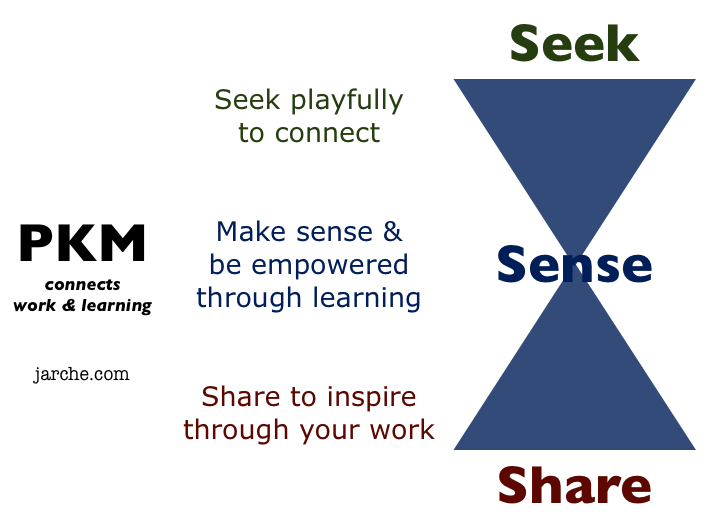
Personal Knowledge Management (PKM) is about taking a personal or individual perspective to Knowledge Management rather than an organisational or corporate one.

In short we have to say PKM is taking responsibility for what you know, who you know- and what they know.

PKM Concept


PKM is mostly focused on individuals who must negotiate and transcend the artificial barriers between their teams, communities of practice, and networks. Inside that person’s head, there are no knowledge barriers. However, discerning with whom and when to share, remains a key part of effective PKM. Social learning requires social intelligence, but organisations have to establish ways to support the multifaceted knowledge worker, or continue to face the knowledge sharing paradox. Understanding that people, not management systems, enable knowledge flow would be a good start.

Reading Alicia's blog  I found she posted some relevant information about PKM and explains it very clearly.

Reflecting on PKM, my thinking is that it connects personal philosophy very well. My personal philosophy of education is primarily based on the ideas of behaviorism. I feel that a behaviorist approach will be necessary in a special child as well as normal child. Behaviorists believe that reinforcement is crucial when it comes to mastering a skill. This is definitely true as most of the students’ need repetition for mastering their skills.

I believe that an effective learning environment begins with a positive climate. Establishing positive classroom environment and strong relationships with students is the first step in proactive behaviour management and individualization. In order to establish these relationships it is imperative to express sensitivity, provide specific positive feedback, and have consistent two-way communication with the families of my students.  The information these relationships will provide will allow me to have greater regard for my students’ perspectives and to better engage my students.


Monday, 24 March 2014

TOOLBELT THEORY

Thank you  Safee  for sharing an insight of "toolbelt theory". I had never come across this theory until I joined EDC3100 module. I fount it is an amazing and very interesting theory as I read through “Toolbelt Theory for Everyone” posted in Ira David Socol's blog. The article  is based on the concept that students must learn to assemble their own readily available collection of life solutions. They must learn to choose and use these solutions appropriately, based on the task to be performed, the environment in which they find themselves, their skills and capabilities at that time, and the ever-changing universe of high and low-tech solutions and supports.


Toolbet of "Information"


According to Socol(2009) “ We as humans differ, our tasks differ, our environments differ, our circumstance differ and we pick the appropriate tool”

So, the Toolbelt theory is designed to:
• Break the dependence cycle
• Develop lifespan technology skills  
• Limit limitations
• Empower student decision making
• Prepare students for life beyond school

All these information inspired me to look back over the weeks and find the ICT tools that I have added to my own personal and future teaching Toolbelt,


Reference

Scocol,l.(2009) .the Toolbelt and universal Design Education for everyone, Retieved  march 6 2014 from http://speedchange.blogspot.com/2008/05/toolbelt-theory-for-everyone.html

Wednesday, 19 March 2014

WHAT IS "ICT AND PEDAGOGY", DO YOU KNOW?

ICT – What is it?

ICT (information and communications technology - or technologies) is an umbrella term that includes any communication device or application, encompassing: radio, television, cellular phones, computer and network hardware and software, satellite systems and so on, as well as the various services and applications associated with them, such as videoconferencing and distance learning. ICTs are often spoken of in a particular context, such as ICTs in education, health care, or libraries.

What is Pedagogy? 

Pedagogy is the way we teach, the strategies behind our teaching and the focus of our teaching. Pedagogy is also about learning; one cannot teach without being a learner. Understanding what is involved in the process of being a learner is part of pedagogy.

Today, this understanding is more important than ever. Educators need to encourage learners (including ourselves) to be creative, adaptable and innovative to fulfil this future. According to Thibault (2000) visual aids are key tools in learning and development since they help increase a student's interest in a subject. They help break the mundane cycle in certain settings, such as in classrooms. Visual aids also tend to be more interactive, helping an audience become more engaged in their own learning.

In one of my colleagues blog I found that the blogger Sanna posted a link to a YouTube on versatile tablet and her reflection. As I read the post and watched the video I felt truly inspired by it. Visit Sanna's blog here Sanna Ahmed's Blog

It reminded me of my childhood education. We never get any opportunities to explore and play with tablets, computers or any ICT tool in our education setting. But today with the aid of these ICT tools children can learn things in different ways. Children focus their attention and interest to the lessons when ICT is incorporated. Due to this factor I strongly believe it is important for educators to be ICT literate and is capable of using ICTs smartly in classroom to maximise student’s learning. 

Watch the YouTube video and follow the link below for better understanding of ICT and  how it help in our education today. 


Reference:
Rouse, M. (2005). What is ict. Retrieved March 15, 2014,
from http://searchcio.techtarget.com/definition/ICT-information-and-communications-technology-or-technologies