Tuesday, 1 April 2014

Why we need curriculum?

Starting week 4 with new goals and with new information’s

Curriculum is a systematic written document which describes, objectives, planned goals, subject content, learning activities and intended learning outcomes which are designed for students to encounter in their learning journey under the guidance of the school for the learners’ continuous growth in personal and social competence.


Early childhood curriculum models also vary in terms of the freedom granted to teachers to interpret implementation of the model’s framework. Some curriculum models are highly structured and provide detailed scripts for teacher behaviours. Others emphasize guiding principles and expect teachers to determine how best to implement these principles. Curriculum models, regardless of their goals and the degree of flexibility in their implementation are designed to promote uniformity across early childhood programs through the use of a prepared curriculum, consistent instructional techniques, and predictable child outcomes. (Epstein, 2008).

A curriculum is not only a collection of academically required subjects. Rather it also considers the aspects of children’s life, the learning needs of students, the time available for the session and the teacher’s idea capability and work load.


Preschoolers are always learning something new every day. They learn simply by being involved in the surrounding around them and having fun doing it. The most important thing of the curriculum is for the teachers to create learning environments with appropriate teaching resources and help children to explore learning through play as this will enhance children’s learning. The different teaching approaches and the methods the teachers use will create a society with skilful, knowledgeable and disciplined citizens with values.


Below  videos will give you more information about curriculum. Have a lookJ


Reference

Epstein, A. (2008). Why early childhood educators should use a curriculum – and one that works. Early Child magazine. 14(9), 12-13. Retrieved march 1st, 2014, fromhttp://www.earlychildhoodaustralia.org.au/every_child_magazine/every_child_index/why_early_childhood_educators_should_use_a_curriculum.html

Monday, 31 March 2014

Assignment 1 Part B - Online Artifacts

The video below regarding online artifacts describes my teaching context and why I will use ICT  in teaching and learning.


Have a look and enjoy!


Download the PDF version here

Saturday, 29 March 2014

Feeling towards my Assignment 1


I have exactly the same feeling as Sanaa. I felt worried and confused on assignment 1b, there was not enough time for learning a new method to do this assignment. I spend long hours looking information on doing my assignment. It looks like an easy assignment with only 1000 words but, to create an ICT based artefacts is not easy for me. 

I read the websites below to find about more on how to do my assignment.


I will keep praying and I hope I can do well in my online artefact and I believe my friends can also do better.

shafeenaz

Why games are good for learning?

Games benefit children in many areas like those of cognitive, social, emotional and communication and language development too.  Also it will capture children’s attention in learning. Take a look at the info-graphic below for an overview of why games are good for leaning.
Why Games are Good for Learning

I like to play treasure hunt, word games and many more with my niece and nephews. They really enjoyed it. In the treasure hunt game, in order to rescue Pirate Jack from the tree, they have to make four words using the letters on the coconuts. They can repeat this game as many times as they wish. I am thinking of using these games for to play with the children during my practicum period.

Constructing a tower using blocks


While searching the web I found this musical chair reading game for Miss Sporn's class. They invented musical chair in a new way. They placed books on each of the chair and played the music. When the music stopped children needed to stop, sit down and start reading! Then when the music started again they walked around in a circle until the music stopped – then sit down and start reading again.  It seems very interesting and lot of fun and something different to develop our reading interests.

Lining for a game of hopscotch


Don't underestimate child's play. It may look like leisure time,  but when children are playing house, fighting imaginary dragons or organising a game of hopscotch, they're actually developing crucial life skills — and preparing their brains for the challenges of adulthood.

Tuesday, 25 March 2014

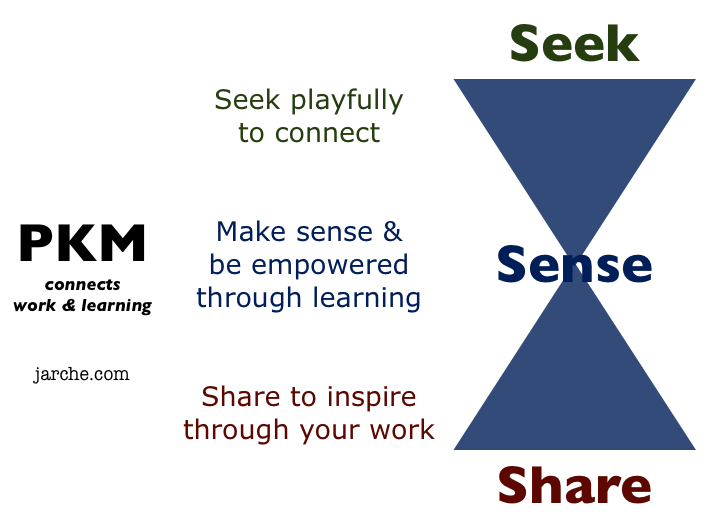
PKM PROCESS AND YOUR PLN

Personal Knowledge Management (PKM) is about taking a personal or individual perspective to Knowledge Management rather than an organisational or corporate one.

In short we have to say PKM is taking responsibility for what you know, who you know- and what they know.

PKM Concept


PKM is mostly focused on individuals who must negotiate and transcend the artificial barriers between their teams, communities of practice, and networks. Inside that person’s head, there are no knowledge barriers. However, discerning with whom and when to share, remains a key part of effective PKM. Social learning requires social intelligence, but organisations have to establish ways to support the multifaceted knowledge worker, or continue to face the knowledge sharing paradox. Understanding that people, not management systems, enable knowledge flow would be a good start.

Reading Alicia's blog  I found she posted some relevant information about PKM and explains it very clearly.

Reflecting on PKM, my thinking is that it connects personal philosophy very well. My personal philosophy of education is primarily based on the ideas of behaviorism. I feel that a behaviorist approach will be necessary in a special child as well as normal child. Behaviorists believe that reinforcement is crucial when it comes to mastering a skill. This is definitely true as most of the students’ need repetition for mastering their skills.

I believe that an effective learning environment begins with a positive climate. Establishing positive classroom environment and strong relationships with students is the first step in proactive behaviour management and individualization. In order to establish these relationships it is imperative to express sensitivity, provide specific positive feedback, and have consistent two-way communication with the families of my students.  The information these relationships will provide will allow me to have greater regard for my students’ perspectives and to better engage my students.


Monday, 24 March 2014

TOOLBELT THEORY

Thank you  Safee  for sharing an insight of "toolbelt theory". I had never come across this theory until I joined EDC3100 module. I fount it is an amazing and very interesting theory as I read through “Toolbelt Theory for Everyone” posted in Ira David Socol's blog. The article  is based on the concept that students must learn to assemble their own readily available collection of life solutions. They must learn to choose and use these solutions appropriately, based on the task to be performed, the environment in which they find themselves, their skills and capabilities at that time, and the ever-changing universe of high and low-tech solutions and supports.


Toolbet of "Information"


According to Socol(2009) “ We as humans differ, our tasks differ, our environments differ, our circumstance differ and we pick the appropriate tool”

So, the Toolbelt theory is designed to:
• Break the dependence cycle
• Develop lifespan technology skills  
• Limit limitations
• Empower student decision making
• Prepare students for life beyond school

All these information inspired me to look back over the weeks and find the ICT tools that I have added to my own personal and future teaching Toolbelt,


Reference

Scocol,l.(2009) .the Toolbelt and universal Design Education for everyone, Retieved  march 6 2014 from http://speedchange.blogspot.com/2008/05/toolbelt-theory-for-everyone.html

Wednesday, 19 March 2014

21ST CENTURY LEARNER

I really want to share this YouTube video with my friends. I enjoyed watching this video because it made me think critically about my future classroom in terms of my teaching and how my students are learning. I really enjoy finding new information and integrating new forms of technologies in my teaching. I truly believe no one sees more clearly than us educators, how the technologies we use in our daily lives influence how students learn. Students have changed, educators have changed, and learning itself has changed. Also learning tools have evolved accordingly.


This is a student's final video project for Master in Education Media and Design Technology.  This video asks faculties that teach students of different age categories to consider "What if they incorporate appropriate technologies to help prepare their students for success in the 21st Century".